The previous post was making the point that in order to know how to move forward in the Transformation Programme, one should start with and be informed by one’s history. Also discussed was that the setting of the Institution’s direction, in this case in the form of Vision and Mission, was crucial to clearly communicate the desired path for the Institution to take. With the overarching strategy down and dusted, it was time to get down to brass tacks.
ENVIRONMENT
After engaging with the current management team, it became clear that the current location of the University was an issue. I could not agree more; when I first participated on the Due Diligence exercise on the University, I actually had trouble locating it. Not that it was in an obscure setting: Leisure Commerce Square, otherwise known as ‘Bali’ near the Sunway double-decker bridge over the Federal Highway was very visible and known. The problem lay in locating the University as one disembarked from one’s vehicle at the main portico – apart from a rather incongruous sign in the middle, the ‘University’ could not be visually sighted. It seems that the ‘University’ was dispersed throughout all three blocks of the office complex, and is accessed via different lifts and staircase verticals and on different floors. In essence, especially if regarded from the viewpoint of architectural phenomenology, the University did not have a sense of place.
In a Transformation Programme, the most tangible impact that could quickly be felt was a change in one’s daily working environment. When trying to impact a mindset change, having a different the ecosystem in which work takes place is absolutely essential. Although the change is not so easily done within a short span of time, it is paramount to have a concrete plan to work towards and to communicate it well. Fortunately, this issue was already flagged during the Due Diligence exercise and efforts were well underway to find a suitable location.
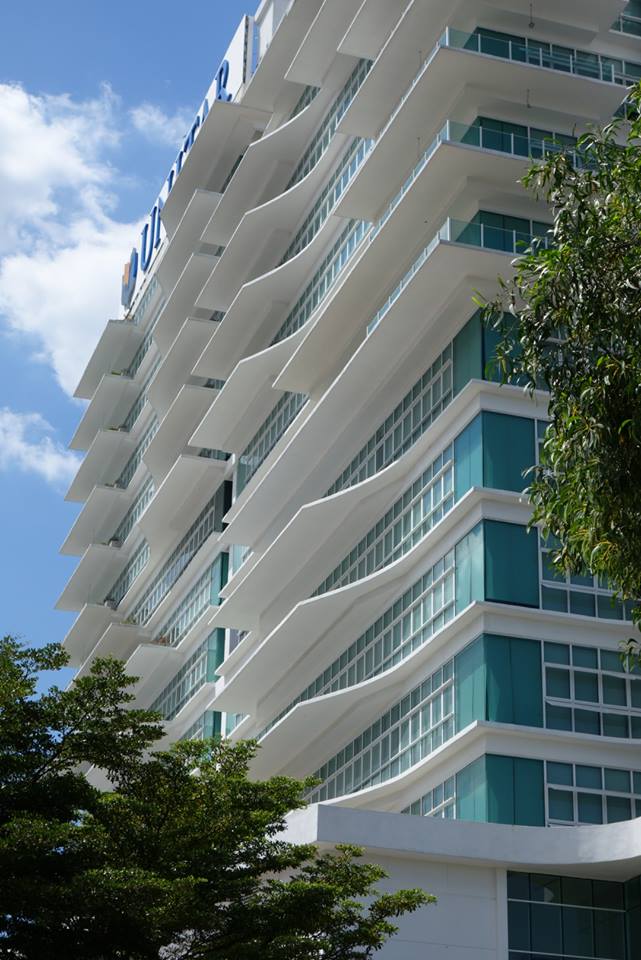
With what can only be described as God’s grace, we finally landed on a new building which was under construction at the time in Kelana Jaya. UNITAR began in 1997/1998 at a shop-office building popularly known as ‘belakang Giant’ (at the back of the original Giant Supermarket) in Kelana Jaya, within visual vicinity of the proposed new Campus. Coming ‘home’ to Kelana Jaya was symbolic of our appreciation of the University’s past, and occupying a new landmark building in the same area amplifies the point. The University’s place-making had begun.
IDENTITY
UMTECH was not a bad name. It could even be convincingly argued that ‘University of Management and Technology’ as a name was fairly progressive. The real issue was that it divorced itself from its roots, its past, its history, and that the name would probably invoke inquiries whether it was newly set-up institution. Upon further engagement with the staff, it became somewhat clearer that their affinity to its original name, UNITAR, was significant. This was even more pronounced with staff who had been with the University north of 8 years. Following further interactions with the proprietors of the University’s Independent Regional Centres (IRC) throughout the country, it was clear that the name UNITAR was much, much preferred. Quipped the Kota Kinabalu IRC Owner “The name UNITAR here is like Harvard”. Hard to argue with that.
Efforts were then undertaken to move from UMTECH to the Board-approved UNITAR International University. The ‘International’ word was included to reflect its new aspirations, one of which was to be of international standing, not merely by having international students. There were some ‘jumping through hoops’ which were necessary both from the regulatory side (with the Ministry of Education) and more importantly, the stewards of the TAR acronym in UNITAR, namely the family of the late second Prime Minister of Malaysia, Tun Abdul Razak. We were overwhelmed and humbled when they acquiesced.
When such victories are earned, it is essential to celebrate. On 18th October 2012, ‘UNITAR International University’ name was launched by the then Minister of Higher Education, Dato’ Seri Mohamed Khaled Nordin. Thus the University was officially renamed, and perhaps, in part, reborn.
CHAMPIONS
A true rebirth could not be achieved of there were no champions. While there were truly committed gems internally, it is usually advantageous to bring in external talent to champion the respective change initiatives and to achieve a good balance of knowledge and persistence. UNITAR was fortunate to have a strong and stable Human Resources Department, often the key to any transformative efforts. Having a private equity company as the main shareholder meant that the university’s financial reporting had to be greatly improved and its financial management much more well-planned. A rather convoluted and hodge-podge IT system, so central to the University which runs in both Conventional Mode (with full face-to-face classes) and Distance Learning Mode (with online forums as a major assessed activity), had to be overhauled and upgraded. The marketing team also had to be addressed, as student intakes had started to plummet even before the completion of the acquisition. Regulatory issues abound concerning both institution and programmes. The situation, to put it mildly, was rather dire.
The search for the right human capital is normally a hit-and-miss scenario; one could only tell the new employee’s performance when they are well into their jobs. From the collective experience of the new management, the one factor that could considerably lower the risk was to hire known resources. Recruitment through one’s own or extended networks often bore better fruit than pure advertising and executive searches. Being known also brings a certain reputational pressure to perform; and this is often considered a good thing.
So began a deluge of talent injection – from former Big Four accounting firms, both public and private universities as well as from the industries of banking and information technology, with the laser-like focus to improve the operations of the University. The Educational and Pedagogical transformation had to wait until the operations were much more robust and stable. The front-end reporting and back-end operations took top priority. This was in parallel to the 100-day Plan conceived as an objectives set as an outcome to the due diligence process. The Transformation, in all intents and purposes, was well underway.
 Rearchitecting.Education